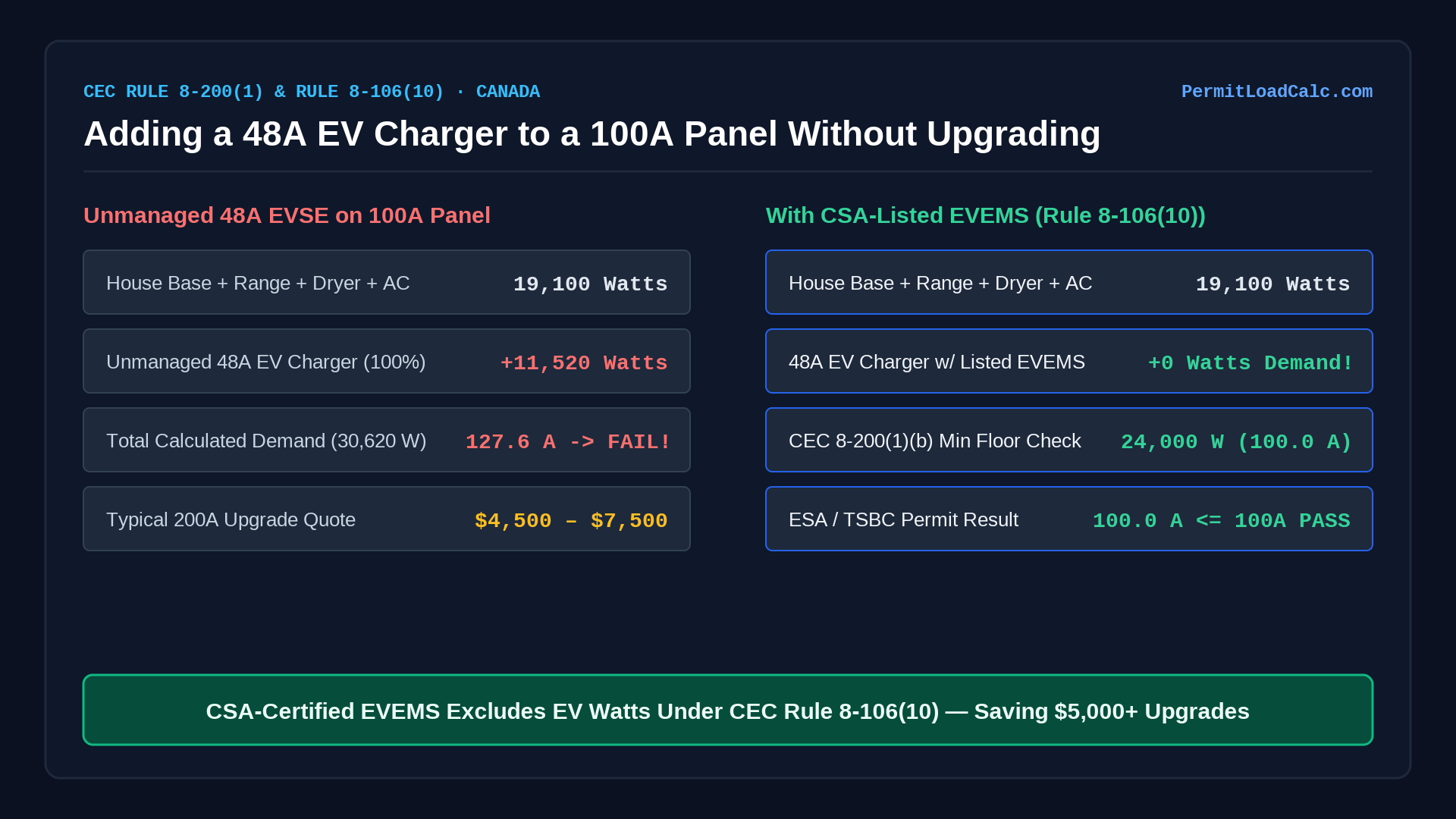
Across Ontario, British Columbia, and Alberta, thousands of homeowners with older 100-amp electrical panels receive $4,500 to $7,500 quotes to upgrade their main service to 200A just to install a Level 2 EV charger. Yet in the vast majority of single-family homes, the Canadian Electrical Code (CSA C22.1) provides a 100% compliant, inspector-approved alternative.
1. Why Standard 100A Panels Fail CEC Rule 8-200(1)
When you apply for an electrical permit with the Electrical Safety Authority (ESA) in Ontario or Technical Safety BC, the inspector evaluates your service using CEC Rule 8-200(1)(a):
- Basic Living Area Load (Rule 8-110 & 8-200(1)(a)(i-ii)): 5,000 W for the first 90 m² plus 1,000 W for each additional 90 m² (counting 75% of basement floor area). For a typical 145 m² home with a 60 m² basement (190 m² effective), that equals 7,000 W.
- Electric Range (Rule 8-200(1)(a)(iv)): 6,000 W base for a standard 12 kW stove.
- Dryer & Water Heater >1,500 W (Rule 8-200(1)(a)(vii)): Factored at 25% when a range is present (e.g., 10,000 W × 25% = 2,500 W).
- Air Conditioning / Heat Pump (Rule 8-200(1)(a)(iii)): Taken at 100% (e.g., 3,600 W).
- Unmanaged 48A EV Charger (Rule 8-200(1)(a)(vi)): Taken at 100% = 11,520 W!
Adding those lines together yields 30,620 W ÷ 240V = 127.6 Amps — exceeding a 100A service by 27.6 Amps and triggering an automatic permit rejection.
See instant PASS / FAIL amperage + download the 4-page AHJ / ESA Permit PDF and vector Single-Line Diagram.
2. The Code Solution: CEC Rule 8-106(10) & (11) (EVEMS)
Under CEC Rule 8-106(10) and Rule 8-500, when an Electric Vehicle Supply Equipment (EVSE) circuit is controlled by a CSA-certified Electric Vehicle Energy Management System (EVEMS) that monitors main service feeders and automatically curtails or disconnects charging whenever household demand approaches 80% of the main breaker rating, the EVSE demand is counted as 0 Watts on the Rule 8-200 service calculation.
In the exact same house above, enabling a listed EVEMS drops calculated demand from 30,620 W down to 19,100 W (governed by the 24,000 W / 100A minimum floor of Rule 8-200(1)(b)) — turning an overloaded 127.6A fail into a 100.0A PASS.
3. What Inspectors Require in Your Permit Upload
To approve an EVEMS installation without a service upgrade, municipal and provincial inspectors expect two clear documents in your application:
- A line-by-line CEC Rule 8-200 Load Calculation Schedule explicitly citing
Rule 8-106(10)/(11)on the EVSE line; - A Single-Line Electrical Diagram (SLD) illustrating the utility meter, 100A main breaker, current transformer (CT) sensors on the main service conductors, and the listed EVEMS controller feeding the EV charger.